
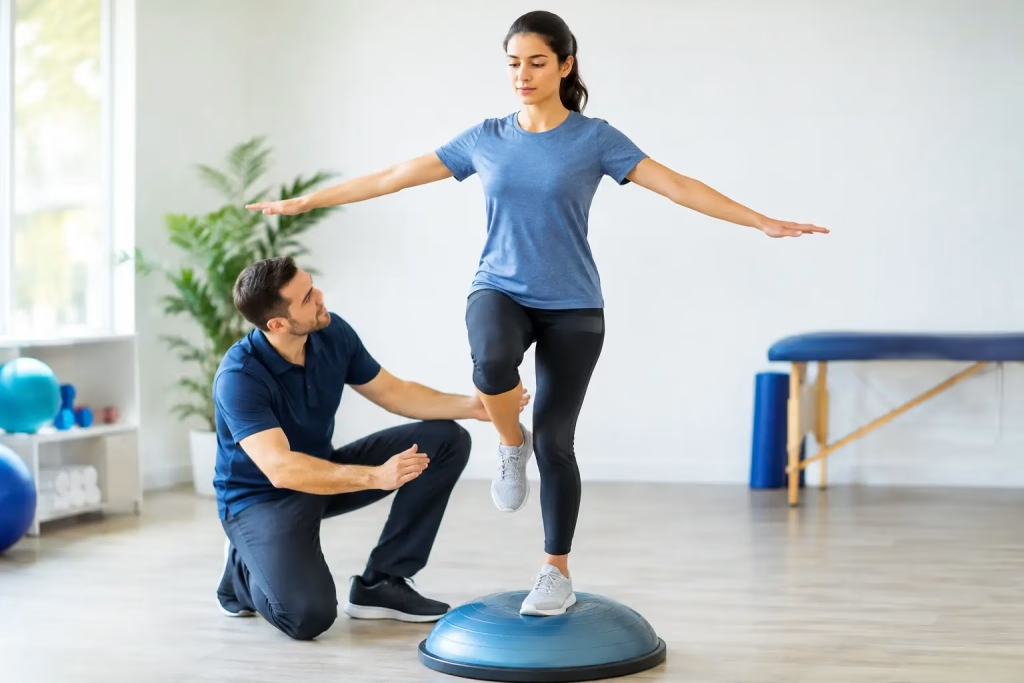
A misstep at the letterbox, a wobble getting out of the car, or suddenly needing the handrail on stairs can knock your confidence as much as the injury itself. Learning how to regain balance after injury is not about forcing yourself to stand on one leg for as long as possible. It is about rebuilding strength, body awareness and trust in your movement, one safe step at a time.
For adults over 40, balance can be affected by far more than the injured area. Pain changes how you walk. Time off your feet can weaken key muscles. Stiffness in the ankle, knee, hip or back can make your body compensate without you realising it. The good news is that balance is trainable, and the right approach can help you return to walking, gardening, golf, gym sessions and everyday life with greater confidence.
Why balance often changes after an injury
Balance is your body’s ability to keep its centre of mass over its base of support. Your brain constantly combines information from your eyes, inner ear, joints and muscles to make tiny adjustments that keep you upright.
After an ankle sprain, knee injury, hip pain or back flare-up, this system can become less efficient. Swelling, pain and reduced movement can alter the messages coming from the injured joint. You may unconsciously put less weight through one leg, take shorter steps or avoid turning quickly. These are sensible short-term protective responses, but if they continue for weeks, they can leave you feeling unsteady even after the original pain has settled.
There is also a confidence factor. A previous fall, a sudden twist, or a painful episode can make you more cautious. Caution is understandable, but avoiding movement altogether can lead to further weakness and stiffness. The goal is not to ignore fear. It is to use safe, progressive practice to show your body that it can move well again.
How to regain balance after injury: start with the basics
Before trying challenging balance drills, make sure the foundations are in place. If you are still limping heavily, have sharp pain, significant swelling, a joint that gives way, or cannot bear weight comfortably, balance exercises may not be the first priority. You may need an individual assessment and a plan that addresses the injury itself.
Start by practising movements that are close to daily life. Stand tall with your feet hip-width apart near a kitchen bench or sturdy chair. Shift your weight slowly from left to right, keeping both feet on the floor. Then shift forwards and backwards, noticing how pressure moves through your feet. This simple exercise helps restore awareness of where your body is in space without putting you in a risky position.
Next, practise sit-to-stands from a firm chair. Keep your feet under your knees, lean forwards slightly, stand up with control, then lower yourself slowly. This builds leg strength and teaches you to manage your centre of gravity during one of the most common daily movements. Quality matters more than quantity. If your knee collapses inward, your back tightens, or you need to push hard with your hands, reduce the range or seek guidance.
Walking is also a balance exercise. Begin on a flat, familiar surface at a pace where you can walk evenly. Focus on a comfortable stride and an even weight shift from one foot to the other. A short daily walk performed well can be more useful than an advanced exercise done once a week with poor control.
Build strength where balance needs it
Good balance depends on strong legs, hips and trunk. You do not need to train like an athlete, but you do need enough strength to catch yourself when you trip, step over a curb, carry groceries or turn suddenly.
Calf raises are particularly useful after foot, ankle and knee injuries. Holding a bench for support, rise onto your toes and lower slowly. Your calves help control the ankle and provide the push-off needed for steady walking. If both legs feel comfortable, progress gradually towards putting more load through the recovering side.
Hip strength matters too. The muscles around the side of your hips help keep your pelvis level when you stand on one leg or climb stairs. A simple starting point is standing side leg lifts while holding a bench. Keep your body upright and move the leg out to the side without leaning away. Small, controlled movement is more valuable than swinging the leg high.
For many people, the best programme also includes knee control, ankle mobility and trunk strength. The exact mix depends on your injury history. Someone recovering from an ankle sprain needs a different emphasis from someone whose balance changed after a knee replacement, back pain or a long period of reduced activity.
Progress balance practice without taking unnecessary risks
Once you can stand and walk comfortably, gradually make the task more demanding. Always practise beside a stable support, especially early on. A kitchen bench is usually safer than a light chair that could move underneath you.
Try standing with one foot slightly in front of the other, as though you are on a narrow path. Hold for 10 to 20 seconds, then swap sides. If that feels steady, bring the feet closer together. From there, try brief single-leg stands while keeping one or two fingers on the bench. The aim is controlled practice, not proving that you can do it without support.
You can make an exercise harder by reducing hand support, increasing the time, changing the surface or adding movement. Only change one element at a time. For example, first progress from two hands to one hand on the bench. Later, use a fingertip for support. Closing your eyes or standing on an unstable surface can be appropriate for some people, but these are not automatic next steps. They increase risk and are best introduced when your physio has confirmed they suit your condition.
Turning, stepping sideways and stepping backwards are equally relevant because real life is rarely straight ahead. Practise taking a controlled step over a low object, turning around the kitchen bench, or side-stepping along it with a hand nearby. These movements can prepare you for tight spaces at home, uneven paths and busy shops.
Know when balance problems need professional assessment
Not every balance issue is simply a strength problem. Book an assessment promptly if your unsteadiness began suddenly, is getting worse, or comes with dizziness, fainting, new headaches, vision changes, numbness, weakness, speech changes or chest pain. These symptoms need medical attention rather than a home exercise plan.
It is also worth seeing a physiotherapist if you have had a fall, keep catching your foot, feel your ankle or knee giving way, or have stopped doing activities because you do not trust your balance. A one-to-one assessment can identify whether the main issue is joint movement, muscle weakness, pain, altered walking technique, vestibular symptoms or a combination of factors.
At Growing Younger Physiotherapy, treatment is tailored to how you actually live. That may mean building confidence for walking around Howick, getting back to a regular fitness class, moving safely around the garden, or simply getting up and down stairs without holding your breath. Hands-on treatment may help where stiffness or pain is limiting movement, but lasting improvement comes from a programme that progressively restores your strength and control.
Make practice part of your week
Balance improves through regular exposure, not one heroic session. A few minutes most days is often more effective than a long session done occasionally. Link your exercises to an existing habit, such as waiting for the kettle to boil or brushing your teeth, provided the area is clear and you have something stable to hold.
Keep a simple note of what you can do: how long you can stand steadily, whether stairs feel easier, or whether you are relying less on furniture when moving around the house. These small changes are meaningful evidence that your body is adapting.
Some discomfort from working recovering muscles can be normal. Sharp pain, increasing swelling, a new limp or symptoms that remain worse the next day are signs that the exercise may be too difficult or the volume too high. Pull back rather than pushing through. The right pace is the one that challenges you while allowing your body to recover and improve.
Regaining balance is not about being fearless. It is about becoming capable again, with enough strength, control and confidence to keep saying yes to the parts of life that matter to you.
