
A wobbly ankle can make an ordinary walk, a round of golf, a gym class or stepping off a kerb feel surprisingly uncertain. The best exercises for ankle stability are not about forcing the joint to become rigid. They help your ankle react quickly, your foot work more effectively and your leg stay in control when the ground is uneven or your balance is challenged.
For adults over 40, ankle stability matters well beyond sport. Strong, responsive ankles support safer walking, easier stairs, better balance and the confidence to keep doing the activities you enjoy. The goal is practical: to help you move with less fear of rolling an ankle, feeling unsteady or avoiding things your body should still be able to do.
What ankle stability really means
Your ankle is not working alone. Stability comes from the muscles around the ankle and foot, but also from your calves, hips and trunk. Your brain also plays a major role, constantly using information from your feet and joints to make small corrections before you lose balance.
That is why simply doing calf stretches or wearing a supportive shoe is rarely the whole answer. Mobility can help, particularly if an old injury has left the ankle stiff. But lasting improvement usually requires strength, balance and controlled exposure to movements that challenge the joint safely.
If you have recently rolled your ankle, have significant swelling, cannot comfortably bear weight, or your ankle repeatedly gives way, get it assessed before starting a home programme. A personalised plan is especially worthwhile after a fracture, surgery or a recurring ankle injury.
Best exercises for ankle stability at home
Start with a level of challenge that lets you maintain good control. Mild muscle effort is expected. Sharp pain, increasing swelling or a sense that the ankle is about to buckle is a sign to stop and adjust the exercise.
1. Calf raises
Your calf muscles help control the ankle every time you push off while walking. They also work hard when you climb stairs, rise onto your toes or catch yourself after a small loss of balance.
Stand near a kitchen bench or sturdy chair. Keep your weight spread through the whole foot, then slowly rise onto both feet and lower with control. Avoid rushing or letting the ankles roll outwards. Aim for two to three sets of 8 to 15 repetitions, two or three times each week.
When double-leg calf raises feel easy, shift more weight onto one leg as you rise, using your fingertips for support if needed. A full single-leg calf raise is useful, but only when you can keep the heel moving straight up rather than twisting or collapsing through the foot.
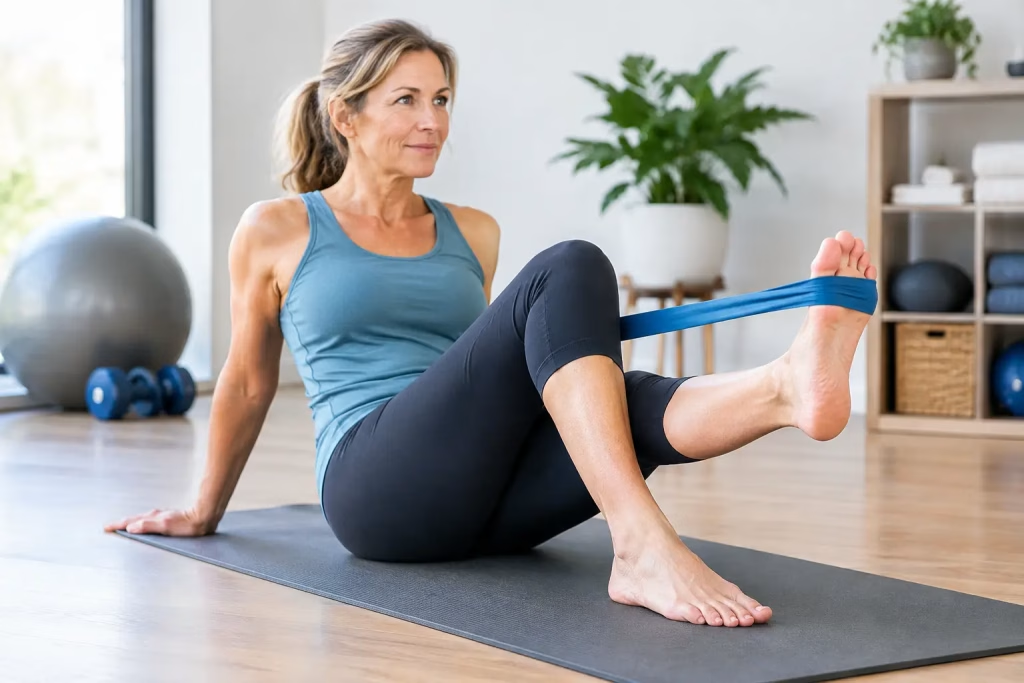
2. Banded ankle turns
The smaller muscles on the outside and inside of the lower leg help stop the ankle from rolling too far. Strengthening them can be particularly useful after a previous sprain.
Sit with your leg straight and loop a resistance band around the front of your foot. Secure the other end to the side, then slowly turn your foot outwards against the band while keeping your knee still. Repeat with the band positioned to resist an inward turn. The movement should come from the ankle, not a twist through the whole leg.
Two sets of 10 to 15 slow repetitions each way is plenty to begin with. Choose a light band at first. Better control beats a heavier band and a sloppy movement.
3. Supported single-leg balance
Balance training teaches the ankle to make rapid, small corrections. It is one of the most useful exercises for people who feel unsteady on uneven ground, but it must be done with sensible support nearby.
Stand beside a bench with one or two fingers resting on it. Lift one foot just clear of the floor and hold your balance on the other leg for 20 to 30 seconds. Keep the standing knee soft, stay tall through your body and try not to grip the floor aggressively with your toes.
Complete two or three holds per side. As this improves, reduce hand support, turn your head slowly from side to side or practise on a folded towel. Do not progress every element at once. A stable surface with less hand support is often a smarter next step than immediately standing on something unstable.
4. Heel-to-toe walking
Walking heel-to-toe is a simple way to challenge balance while moving. It is more relevant to everyday life than standing still, and it reveals whether one side feels less controlled than the other.
Use a clear stretch of bench, hallway or footpath with something close by to steady yourself. Place the heel of one foot directly in front of the toes of the other, then take slow, deliberate steps. Look ahead rather than down at your feet where possible.
Try 10 to 20 steps, turn carefully and repeat. If this feels too difficult, leave a small gap between heel and toe. The aim is controlled movement, not passing a balance test.
5. Step-downs from a low step
Many ankle problems show up when the body is lowering, such as stepping down from a kerb or walking downstairs. Step-downs build strength and control through the ankle, knee and hip together.
Stand on a low step with one foot close to the edge. Slowly lower the opposite heel towards the floor, then press through the standing foot to return. Keep the standing knee roughly in line with the middle toes. If your knee falls inward or your foot collapses, reduce the depth or hold a rail.
Start with two sets of 6 to 10 repetitions per side. This exercise should feel like work through the leg, not like a sharp pinch in the ankle or knee.
6. Controlled side steps
Sideways movement asks the ankles and hips to control your body in a direction that normal forward walking does not challenge very much. It is helpful for gardening, court sports, quick changes of direction and recovering your balance after an awkward step.
Place a light resistance band around your lower legs or above your knees. Bend your knees slightly, keep your feet pointing forward and take small steps sideways. Do not drag the trailing foot or let your knees cave in. Walk six to 10 steps in each direction for two or three rounds.
If the band causes you to twist through your feet, remove it and master the movement without resistance first.
How often should you train ankle stability?
Most people do well with focused ankle work two to three times a week. Balance drills can be done more often because they are low load, provided they do not leave you sore or fatigued. Consistency matters more than long sessions. Ten focused minutes after a walk or before strength training can make a meaningful difference over several weeks.
Progress slowly. First improve control, then increase repetitions, then reduce support or add movement. Jumping, fast direction changes and unstable surfaces have a place for some people, but they are not the starting point for everyone over 40. If your main goal is confident walking, stairs and exercise, controlled strength and balance work may be exactly what you need.
Do your shoes matter?
Shoes can influence how steady you feel, especially if the sole is worn smooth, the heel is unstable or there is not enough room for your toes. However, footwear alone cannot replace the ability of your muscles and nervous system to respond when your foot lands awkwardly.
Choose shoes that suit the activity and feel stable underfoot. Then build the capacity to move well in them. If you rely on an ankle brace after a recent injury, it may be useful in the short term, but pair it with rehabilitation so confidence does not depend on the brace forever.
When a physiotherapy assessment can help
A generic exercise list cannot identify why your ankle feels unstable. It may be reduced calf strength, limited ankle movement, poor balance, an old ligament injury, pain from the foot, or a hip and knee control issue. The right solution depends on what is driving the problem.
At Growing Younger Physiotherapy, one-to-one assessment can identify the movements that are holding you back and give you a clear plan that fits your goals, whether that is returning to walking tracks, keeping up with grandchildren or simply moving around your day without second-guessing every step.
Start where you are, keep the challenge manageable and practise regularly. A steadier ankle is built one controlled step at a time.
