
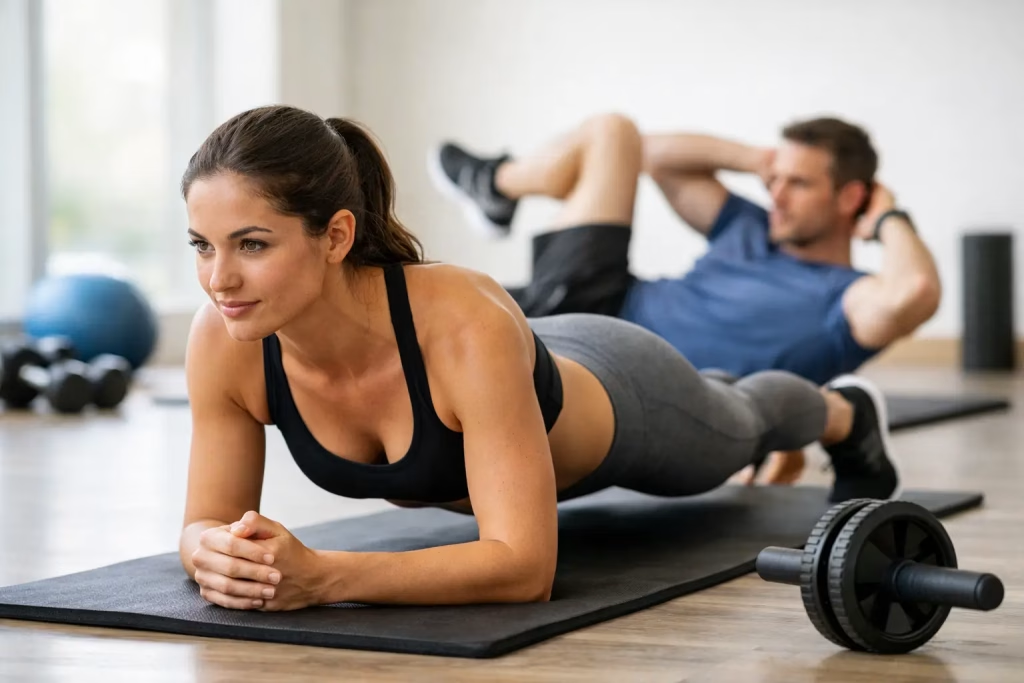
A sore back rarely means your back is the whole problem. For many adults over 40, the real issue is that the muscles around the boot are not doing their share of the work. That is why the best core exercises for back health are not flashy crunch variations. They are simple, well-chosen movements that help you support your spine during everyday life.
If your back feels stiff getting out of bed, grumbles after gardening, or tightens up after a long day at work, improving core strength can make a real difference. But there is a catch. The right exercises depend on your symptoms, your current strength, and whether you are dealing with plain deconditioning or an actual injury. More is not always better, and harder is not always smarter.
What makes the best core exercises for back pain?
When people hear the word core, they often think about abs. In practice, your core includes the deeper muscles around your boot, lower back, pelvis, and hips. Their job is not just to look toned. Their job is to create support, control movement, and reduce unnecessary strain through your spine.
For back support, the best exercises usually have three things in common. First, they teach you to brace without holding your breath or tensing everything. Second, they build endurance, because your back needs support all day, not just for ten seconds in the gym. Third, they keep your spine in a comfortable range rather than pushing it into repeated bending or twisting if that already irritates your symptoms.
That matters even more after 40. Natural changes in strength, recovery, flexibility, and joint tolerance mean you often need a more targeted approach. The goal is not to train like a twenty-year-old. The goal is to stay strong, mobile, and confident doing the things that matter to you.
1. Abdominal brace
This is the starting point because every other exercise works better when you can gently switch on your boot muscles. Lie on your back with your knees bent, or practise it standing if getting on the floor is awkward. Breathe in, then as you breathe out, gently tighten around your lower tummy as if preparing for a light poke. You should still be able to breathe and talk.
It sounds basic, but it teaches control without over-gripping. Many people either do nothing or go too hard and brace like they are lifting a fridge. For back support, aim for about 20 to 30 per cent effort. That is usually enough.
2. Glute bridge
A lot of lower back discomfort comes from the back trying to do a job the hips should be helping with. The glute bridge strengthens the backside and teaches better load sharing through the pelvis and boot.
Lie on your back with knees bent and feet flat. Gently brace, then press through your heels and lift your hips until your shoulders, hips, and knees roughly line up. Pause, then lower slowly. If you feel cramping in the hamstrings, bring your feet a little closer or focus on squeezing through the buttocks instead of pushing your lower back up.
This is one of the best options for people who sit a lot, feel weak through the hips, or notice back soreness after walking uphill or standing for long periods.
3. Dead bug
The dead bug is excellent for teaching boot control while the arms and legs move. That matters because back pain often shows up during movement, not when you are lying still.
Start on your back with hips and knees bent to 90 degrees and arms reaching up. Brace gently. Lower one heel towards the floor while the opposite arm moves overhead, then return and switch sides. Move slowly and only as far as you can without your lower back arching or your ribs flaring up.
If this feels too awkward at first, keep the arm movement out and just tap one heel down at a time. Small, controlled reps beat big sloppy ones every time.
4. Bird dog
This is one of the best core exercises for back stability because it builds control across the whole boot while also training balance and coordination. It is especially useful if your back feels vulnerable when reaching, lifting, or changing position.
Start on hands and knees. Brace gently, then slide one leg back behind you. If that feels steady, reach the opposite arm forward. Hold briefly, then return and change sides. The key is to stay long and level through the torso. If your hips rock or your back sags, make the movement smaller.
Some people rush this exercise and turn it into a wobble. Slow and tidy works better. Think quality, not range.
5. Side plank
Side planks target the muscles that help stop your trunk collapsing sideways. Those muscles matter more than many people realise, particularly for walking, stairs, carrying shopping bags, and getting in and out of the car.
Begin with a bent-knee version if needed. Prop yourself on one forearm with knees bent, then lift your hips off the floor and hold. Keep your chest open and avoid rolling backwards. Once that feels manageable, progress to the full version from the feet.
This exercise can be challenging, so there is no prize for going straight to the hardest level. Even short holds with good form can be very effective.
6. Modified curl-up
Traditional sit-ups are often not the best choice for sore backs, especially if repeated spinal flexion stirs things up. A modified curl-up gives you some abdominal work without as much compressive or bending load.
Lie on your back with one knee bent and the other leg straight. Place your hands under the natural curve of your lower back. Lift your head and shoulders slightly off the floor, keeping your neck long, then lower down. This is a small movement, not a full crunch.
If you feel neck strain, reduce the lift or skip this one for now. Not every exercise suits every back, and that is normal.
7. Pallof press
If you have access to a resistance band, the Pallof press is a brilliant standing option. It trains your body to resist rotation, which can help when twisting, carrying, or reaching across your body.
Anchor the band to one side and stand sideways to it. Hold the band at chest height, brace, then press it straight out in front of you without letting your boot twist. Bring it back in with control. You will feel your core working to keep you steady.
This is a practical exercise for real life because life rarely happens lying on a mat.
8. Farmer carry
Carries are underrated. They are simple, functional, and very effective for building full-body support. Hold a dumbbell, kettlebell, or even a loaded shopping bag in one hand and walk slowly with tall posture. Resist the urge to lean.
This challenges the muscles that stabilise your spine, hips, and boot while you move. Start light and focus on posture rather than bravado. If walking with one-sided load feels too provocative, use two lighter weights instead.
How to use these exercises safely
For most people, two to four exercises in one session is enough to start. You do not need an hour. Ten to fifteen minutes, done well three or four times a week, can be more useful than one heroic session on a Sunday.
A sensible starting point is 6 to 10 controlled reps or short holds of 10 to 20 seconds, depending on the exercise. Mild muscle effort is fine. Sharp pain, increasing leg symptoms, or pain that lingers well after you finish is a sign to stop and reassess.
This is where many people get stuck. They either avoid exercise completely because they are worried about making things worse, or they copy workouts online that are too aggressive for their stage. Back pain is not one-size-fits-all. A person with general stiffness may tolerate planks well, while someone with an irritated disc or spinal arthritis may need a more tailored starting point.
When core work alone is not enough
Core strength helps, but it is not magic. If your back pain is persistent, keeps returning, or is stopping you from working, sleeping, walking, or exercising, it is worth getting properly assessed. Sometimes the missing piece is hip mobility. Sometimes it is technique with lifting. Sometimes it is confidence after an old injury.
That is why a personalised plan matters. At Growing Younger Physiotherapy, we see plenty of active adults who have already tried generic back exercises and got nowhere. Once the right movements are matched to the right problem, progress usually becomes much clearer.
If you are over 40 and want a stronger back, think less about hammering your abs and more about building steady, reliable support around your whole boot. Start with the exercise you can control well, not the one that looks the most impressive. Your back tends to respond best when strength is built with patience, consistency, and just enough challenge to move you forward.
