
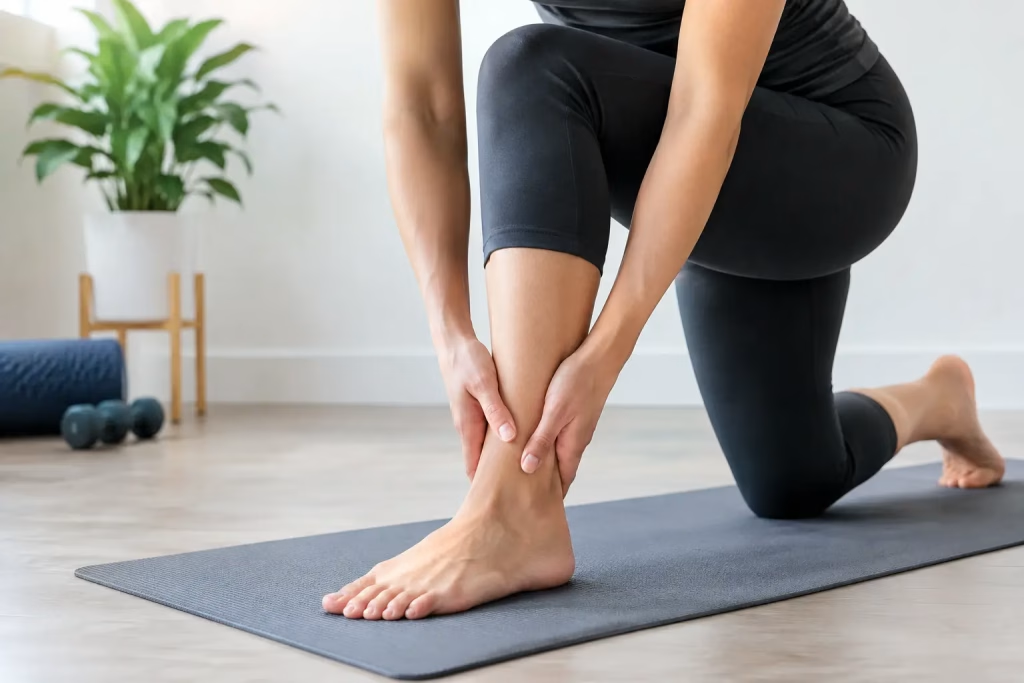
Your ankles do far more than move your feet. They help you get out of a chair, walk down a slope, climb stairs, squat in the garden and steady yourself when the footpath is uneven. When they become stiff, everyday movements can feel harder than they should. The good news is that most people can improve ankle mobility with consistent, well-chosen movement rather than forcing painful stretches.
For adults over 40, ankle stiffness is often gradual. You may notice your heels lifting when you squat, a pulling sensation in your calves on stairs, or less confidence with balance. These changes are worth addressing early, especially if they are beginning to affect the activities that keep you active and independent.
Why ankle mobility matters after 40
Ankle mobility usually refers to how well your ankle can bend forwards over your foot. This movement is called dorsiflexion, but you do not need to remember the term to appreciate its role. You need it each time your knee moves forward over your toes while walking, stepping down, cycling or rising from a low seat.
If the ankle does not move well, your body will find movement elsewhere. Your foot may roll in, your heel may lift early, or your knee and hip may take on more load. That does not mean a stiff ankle is always the cause of knee, calf, hip or back pain. Bodies are more complicated than that. But restricted ankle movement can be one contributing factor, particularly when it changes how you walk, squat or exercise.
Better ankle movement can support a smoother walking pattern, more comfortable squats and lunges, improved balance, and easier stair climbing. It may also make activities such as golf, bowls, gym classes and longer walks feel more natural again.
First, work out what is actually stiff
A tight calf is a common reason for limited ankle movement, but it is not the only one. Previous ankle sprains, swelling, arthritis, footwear, long periods of sitting and reduced activity can all play a part. Sometimes the joint itself feels blocked at the front of the ankle. In other cases, the stretch is mostly through the calf or Achilles tendon.
Try this simple check at home. Stand facing a wall with one foot in front. Keeping the heel down, gently move the front knee towards the wall in line with the second toe. See how close your toes can be to the wall while your knee touches it without the heel lifting or the foot rolling inward.
Compare both sides, but do not panic if they are not identical. A small difference is common. More useful questions are whether the movement is painful, whether one side is clearly restricted, and whether it affects the things you want to do. Sharp pain, catching, giving way, significant swelling or an inability to take weight after an injury should be assessed rather than stretched through.
Practical ways to improve ankle mobility
The best approach is usually a combination of gentle joint movement, calf flexibility and strength. Mobility gained without control tends not to last. Aim for movements that are comfortable and repeat them regularly – five to 10 minutes most days is often more useful than one long session once a week.
1. Knee-to-wall ankle rocks
Stand facing a wall in a split stance. Place the front foot flat on the floor, then slowly guide the front knee towards the wall while keeping the heel planted. Let the knee travel in the same direction as the toes, rather than collapsing inward.
Pause briefly at a mild stretch or firm resistance, then return to the start. Complete eight to 12 slow repetitions on each side. If the movement feels pinchy at the front of the ankle, reduce the range and keep it gentle. Pain is not a sign that the exercise is working.
2. Calf stretch with a straight knee
Place both hands on a wall and step one leg back. Keep the back knee straight, the heel down and the toes pointing forward. Shift your body forwards until you feel a steady stretch in the upper calf.
Hold for 20 to 30 seconds, then repeat two or three times. This position targets the larger calf muscle that crosses the knee and can influence ankle movement when the leg is straight, such as during walking.
3. Calf stretch with a bent knee
Use the same position, but bend the back knee slightly while keeping the heel on the ground. You should feel the stretch lower in the calf, closer to the Achilles region. This variation is particularly relevant for stair climbing, squatting and walking downhill because the knee is often bent during these tasks.
The difference may feel subtle. That is fine. Keep the stretch controlled and avoid bouncing.
4. Supported heel raises
Hold a kitchen bench or sturdy chair for support. Rise slowly onto the balls of both feet, pause for a second, then lower with control. Start with two sets of eight to 12 repetitions.
Strong calves help your ankles cope with the movement you are trying to gain. As this becomes easier, progress to single-leg heel raises or use the edge of a step only if you can do so without pain or loss of balance. For many people, this strength work is the missing piece between being flexible on the lounge room floor and moving well in real life.
5. Controlled step-downs
Stand on a low step while holding a rail or bench. Slowly lower one heel towards the floor, allowing the supporting knee to move forward over the toes while the heel stays down. Return to the top with control.
This is a practical way to build ankle mobility, leg strength and confidence for stairs at the same time. Begin with a very low step. The right height is one that lets you move smoothly without knee pain, wobbling or gripping through the toes.
Avoid the common mistakes
The most common mistake is pushing hard into pain. Stiffness can feel uncomfortable, but sharp, increasing or lingering pain is a reason to stop and get advice. Be especially cautious if you have an irritated Achilles tendon, a recent sprain, inflammatory arthritis, diabetes-related loss of feeling in the feet, or a history of fracture.
Another mistake is treating the ankle in isolation. If your foot is weak, your balance is poor or your hip strength has dropped, ankle exercises alone may not change your walking or squatting pattern as much as you hope. Your footwear matters too. A very stiff boot may temporarily limit movement, while a sudden switch to flatter or more flexible shoes can overload calves that are not ready for it.
Finally, avoid expecting an overnight fix. A joint that has been stiff for months or years often responds best to regular exposure to manageable movement. You may notice early changes within a couple of weeks, while strength, confidence and lasting improvement take longer.
When ankle stiffness needs a physiotherapist
It is sensible to seek an assessment if ankle movement remains limited despite a few weeks of consistent exercise, if you have recurrent sprains, or if pain is stopping you from walking, exercising or sleeping comfortably. A one-to-one assessment can identify whether the restriction is coming mainly from the joint, calf, Achilles tendon, foot mechanics or a previous injury.
At Growing Younger Physiotherapy, treatment is tailored to the way you need to move in daily life – whether that is getting back to your walking group, keeping up with grandchildren, returning to the gym or simply getting up and down stairs without hesitation. Hands-on treatment may help where appropriate, but it is always paired with a clear exercise plan so you can build lasting control and strength.
Start small, move regularly and pay attention to what changes. A more mobile ankle will not solve every ache, but it can make the everyday movements that matter feel steadier, stronger and more comfortable.
